Beyond20 Awarded NASA SEWP VI Contract
Beyond20, a ServiceNow Elite Partner specializing in technology consulting, implementation, and managed services, announced today that it has been awarded…


If you’re responsible for a ServiceNow platform, you already know it does not stand still. New capabilities are released regularly. Business needs shift. Backlogs grow. And internal teams are often asked to support more use cases without additional capacity.
That reality is why ServiceNow managed services exists.
This article is part of a broader series exploring the ServiceNow partner ecosystem, including how implementation partners, advisory partners, and managed services partners each play different roles. If you’re still getting oriented, you may also find these articles helpful:
Here, we’ll focus specifically on managed services. What it is, why it can feel complex to understand, and how to think about different support approaches so you can determine what actually fits your organization.
A ServiceNow managed services partner supports organizations after their ServiceNow platform is live. Rather than focusing on one-time projects, managed services is designed to provide ongoing assistance that helps teams maintain, improve, and extend their platform over time.
That support may include system administration, enhancement delivery, backlog management, process guidance, or a combination of all three. The specific shape of the engagement depends on how the partner structures its support model and how closely it aligns to the organization’s needs.
This is where confusion often begins.
Managed services is a broad category, and partners interpret it differently based on their delivery philosophy.
Some partners emphasize efficiency and ticket-based execution. Others focus on steady-state administration. Still others take a more embedded approach, staying closely involved as priorities evolve.
These differences are not cosmetic. They affect:
Understanding these distinctions makes it easier to evaluate options and avoid choosing a model that works against how your organization actually operates.
Instead of starting with hours or contracts, it helps to start with how work shows up over time.
Most organizations see their ongoing ServiceNow needs fall into one or more of these patterns:
Each pattern benefits from a different type of support. When the managed services approach aligns to these patterns, work moves forward steadily. When it does not, teams often experience friction, delays, or unnecessary rework.
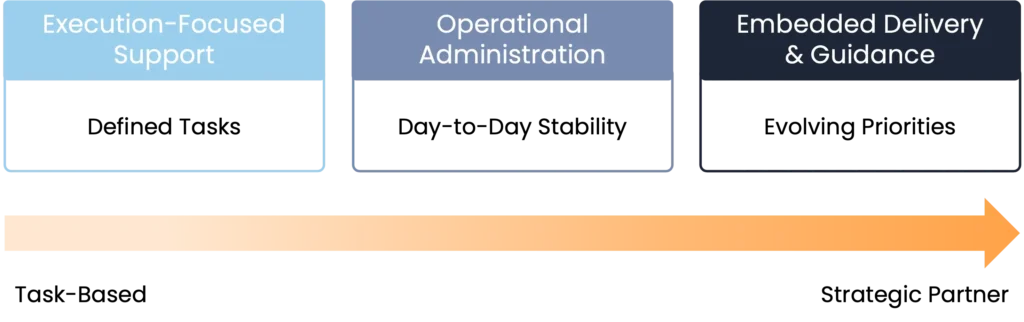
While no two partners structure managed services the same way, most approaches emphasize one of the following support philosophies.
This approach is designed for situations where tasks are well understood and clearly scoped. Requests are submitted, reviewed, and completed independently, often using a prepaid pool of hours.
Execution-focused support works best when:
Beyond20 supports this type of engagement through its ServiceNow System Administration (SNSA) model, which provides consumption-based access to experienced technical consultants for approved requests. The emphasis is on efficient execution while maintaining transparency and control.
Some organizations have a stable ServiceNow environment that still requires consistent day-to-day support. User access changes, routine maintenance, and operational issues must be addressed reliably to keep the platform running smoothly.
This approach emphasizes:
Beyond20’s Momentum Managed Services offering is designed for organizations in this stage. It focuses on steady-state system administration delivered through a consistent monthly allocation, without introducing unnecessary complexity or overhead.
In other environments, ServiceNow work does not arrive neatly packaged. Priorities shift. New stakeholders get involved. Process and platform decisions are tightly connected.
An embedded approach is designed to support:
Beyond20 addresses this need through a pod-based support model, where a consistent, cross-functional team remains engaged week over week. This approach blends process guidance and hands-on delivery within a regular planning and delivery cadence, allowing work to evolve while maintaining momentum.
| If your organization needs… | A model designed for… |
|---|---|
| Help completing defined ServiceNow tasks as needed | Execution-focused support |
| Reliable day-to-day platform administration | Ongoing operational administration |
| Continuous improvement with shifting priorities | Embedded delivery and guidance |
This table is not meant to prescribe a solution, but to help teams recognize which pattern best reflects how their ServiceNow work actually shows up.
Once you understand which support pattern applies, a few practical questions can help narrow the field:
Clear answers to these questions often reveal whether a managed services model will support your goals or create friction over time.
Two partners may both describe their offering as “ServiceNow managed services” and deliver very different experiences. The difference usually lies in how work is planned, how teams stay aligned, and how adaptable the model is as needs change.
For organizations using ServiceNow as a business transformation platform, managed services is not just about keeping the platform running. It is about sustaining progress, making informed decisions, and ensuring the platform continues to support the organization as it grows.
Choosing a managed services partner starts with understanding the approach behind the offering, not just the name on the contract.
Beyond20 is a ServiceNow Elite Partner dedicated to changing work life for our clients through rapid time to value across the ServiceNow platform. We help organizations make ServiceNow work in practice and for people, combining platform-spanning expertise, practical guidance, and hands-on delivery to help teams move with confidence and see value faster.