
Understanding the Common Service Data Model (CSDM) in ServiceNow
The Common Service Data Model (CSDM) serves as a unified framework that helps organizations manage and illustrate their services and related data…


AI Agents are showing up everywhere in the ServiceNow ecosystem right now. Product updates, roadmaps, and conversations increasingly assume a working understanding of what they are and how they fit into day-to-day operations.
For many teams, the challenge isn’t a lack of interest. It’s figuring out what’s relevant, what’s actionable, and what actually applies to their environment. There’s a difference between staying informed and feeling pressured to adopt something before it’s clear how it helps.
This article takes a practical view. Rather than focusing on trends or promises, it looks at how ServiceNow AI Agents work, where they tend to provide real value, and how to approach implementation in a way that supports teams instead of overwhelming them.
At a practical level, ServiceNow AI Agents are designed to reduce the amount of manual effort required to keep work moving. They help interpret context within the platform and take action inside workflows that would otherwise depend on people checking fields, making decisions, or moving work along by hand.
What’s important is that they aren’t operating in isolation. Because they’re built into the ServiceNow platform, they rely on the same data, process logic, and integrations your teams already use. That connection is what allows them to be useful instead of disruptive.
When AI Agents work well, they don’t announce themselves. They quietly remove friction from everyday work.
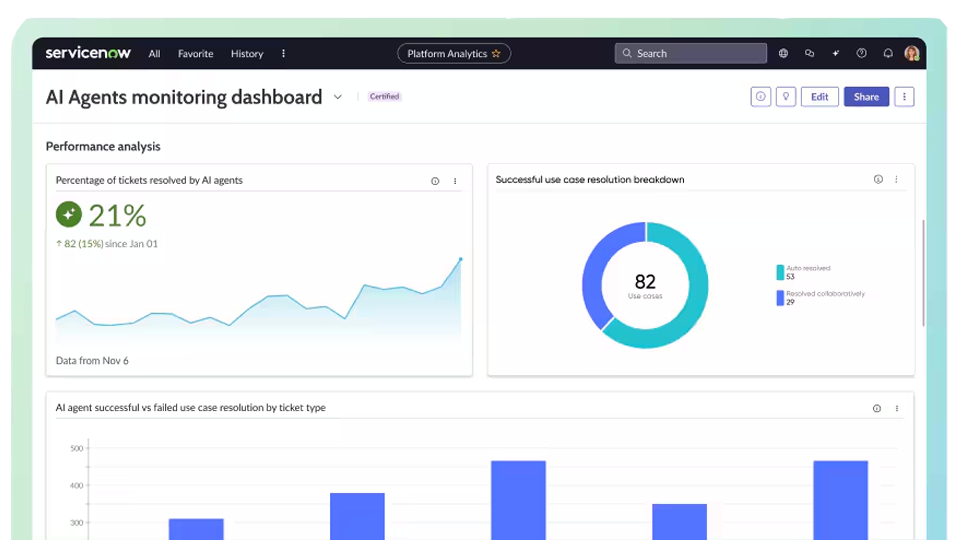
A lot of AI tools promise intelligence but require teams to manage yet another system, data source, or interface. ServiceNow AI Agents take a different approach by working within the structure that already exists.
That means outcomes are shaped less by novelty and more by readiness. Clear workflows, consistent data, and shared definitions matter more than advanced configuration. In many cases, the groundwork teams have already done determines how effective agents will be.
This is where expectations need to be grounded. AI Agents amplify what’s already there. They don’t replace the need for thoughtful process design.
Behind the scenes, AI Agent Studio is where teams define how agents behave. This includes what data they can access, which actions they’re allowed to take, and how they respond to different conditions.
As usage grows, orchestration becomes important. When multiple agents are involved, they need to share context and work together intentionally. Without that coordination, even well-designed agents can create unnecessary overlap.
For many teams, pre-built agents provide a practical starting point. They handle common scenarios and can often be adjusted without significant customization. Starting here allows teams to learn how agents behave in their environment before expanding further.
One of the easiest ways to stall an AI initiative is to treat it as a platform-wide transformation from day one. A more sustainable approach starts with identifying where work consistently slows down or feels heavier than it should.
These moments often show up in handoffs, triage, and routine decision-making. They’re not always dramatic, but they add up over time. Addressing a few of these areas thoughtfully tends to deliver more value than broad experimentation.
From there, decisions about configuration become clearer. Some needs are well served by pre-built agents. Others require more tailored logic. Either way, the goal is to support existing teams, not redesign how they work overnight.
Across ServiceNow environments, AI Agents are already contributing in practical, everyday ways.
In IT Service Management, they help reduce the time spent categorizing, routing, and prioritizing requests. This allows support teams to focus more on resolution and less on administrative overhead.
In customer-facing workflows, agents support consistency by helping cases move to the right place faster and surfacing relevant information at the right time.
In HR and employee services, they help standardize responses to common requests, reducing delays and improving the experience for employees who just want clear, timely answers.
These outcomes aren’t about replacing people. They’re about giving teams more space to apply judgment where it actually matters.
AI Agents tend to expose underlying issues rather than hide them. If data is fragmented or processes are unclear, agents will struggle to produce reliable results. Addressing those gaps early prevents frustration later.
Adoption is another common challenge. Teams are understandably cautious when automation enters the picture. Clear communication, realistic expectations, and visible early wins go a long way toward building trust.
Security and compliance also need to be part of the conversation from the start. Because agents interact with live data, guardrails and governance matter just as much as configuration.
The most useful indicators of success are often straightforward. Are fewer manual steps required? Is work moving more smoothly between teams? Are people spending less time managing requests and more time resolving them?
These signals tend to show up before formal ROI calculations. Over time, they provide a clearer picture of whether AI Agents are genuinely supporting the organization or simply adding another layer of complexity.
ServiceNow AI Agents are not a mandate, and they’re not a shortcut. They’re a capability that works best when applied thoughtfully and in context.
For teams navigating a crowded AI landscape, the most effective approach is often the calmest one. Focus on relevance, start where the impact is clear, and build from there. When AI Agents are implemented with that mindset, they become part of how the platform supports everyday work rather than something teams have to manage around.