
ITIL Maturity Assessment | Global Aviation Technology Provider
Cleared for Improvement: How a Global Aviation Technology Provider Turned ITIL Maturity Findings Into a ServiceNow Roadmap The Client This…


The rise of modern ways of working, which includes movements like Agile and DevOps, has significantly changed how we look at Project Management. It is not the same discipline it was when I first became a Project Manager 15 years ago. We’ve learned more about what makes projects and programs successful and, as a result, we’re pushed to do better. Part of “doing better” is continuing to learn and grow in our knowledge as well as the way in which we work.
The best Project Managers continually add to their toolset, and ITIL 4 is one of the topics that is worth developing a working understanding of for Project Management. This article will discuss what we as Project Managers need to know about ITIL 4: how it relates to the work that we do and the value that it brings to our teams, organizations, and customers. We will also discuss how ITIL 4 is different from previous versions of ITIL and provide an overview of ITIL 4’s “Project and Program Management” practice guide. Let’s start by looking at how the focus of managing projects has changed and where ITIL 4 comes in.
Unfortunately, Project Managers and their teams can deliver projects that are on time and under budget, and the project can still be a complete failure. Customers care about getting products and services that solve a significant challenge or need. They want products and services that excite and delight them, ones that last and get better over the long-term. No one’s going to look back and exclaim, “At least the project was delivered faster and for less money than we expected!”
Instead, they’re going to complain about how bad the product or service is, and they’re not going to use it; and our organization will have wasted a tremendous amount of time and money delivering something that doesn’t measure up to our customers’ expectations. Fortunately, the best Project Managers, teams, leaders, and organizations avoid this result by changing their perspective on what constitutes project success, and it starts with shifting our mindset and being singularly focused on bringing value to those we serve. PMI calls this concept Benefits Realization Management (and the PMBOK Guide talks about the importance of tying projects to the strategic objectives of the organization). ITIL 4 calls this concept “enabling value,” and it’s the beacon that should guide everything we do.
The other challenge we face as Project Managers is the fact that projects, by design, are temporary and have specific start and end dates. As a result, two things happen. First, Project Managers and project teams are often tempted to make decisions that benefit the organization, customer, or other stakeholders in the short-term (for example, we may decide on a platform that gets our customers up and running more quickly, but it may not be the best long-term decision over the life of the product or service). Second, there ends up being a handoff to operations that, at best, involves a transfer of knowledge to a new team. Unfortunately, what more commonly happens, is that the project team “throws” the product or service “over the wall” to an operations team that has to support it; and that transition (and ongoing support) ends up being pretty bumpy.
In an effort to address these challenges, many organizations have changed their organizational structures and how teams fundamentally work, as well as their budgeting structures away from that of funding projects to funding ongoing programs and/or product management initiatives. So, what does this mean for Project Managers? It means that we need to change our perspective on how we look at projects. Not only do we need to make decisions based on what will benefit the product or service over the long-term, we also need to understand how we fit into the bigger picture of the organization.
This is where ITIL 4 can help.
ITIL 4 is the internationally recognized best practice on how we, as a “service provider” organization, develop and deliver innovative products and services to our customers and the overall marketplace. This concept of “Service Management” has remained unchanged since the creation of the ITIL framework (more on that later). What’s different and new in ITIL 4 is the inclusion of modern ways of working like Agile, DevOps, Lean, etc. and the emphasis placed on looking at our organization as a system, which ITIL describes using the Service Value System (or SVS). A diagram of the SVS is shown below alongside PMI’s Benefits Realization Management framework as both are focused on delivering value and benefit to our customers. The SVS gives Project Managers context on how the work we do fits into the bigger picture; and if we want to become effective project leaders within our organization, it requires an understanding beyond the edges of when our projects start and stop. Benefits Realization Management (or BRM) provides organizations with a way to measure how projects and programs add true value to the enterprise.
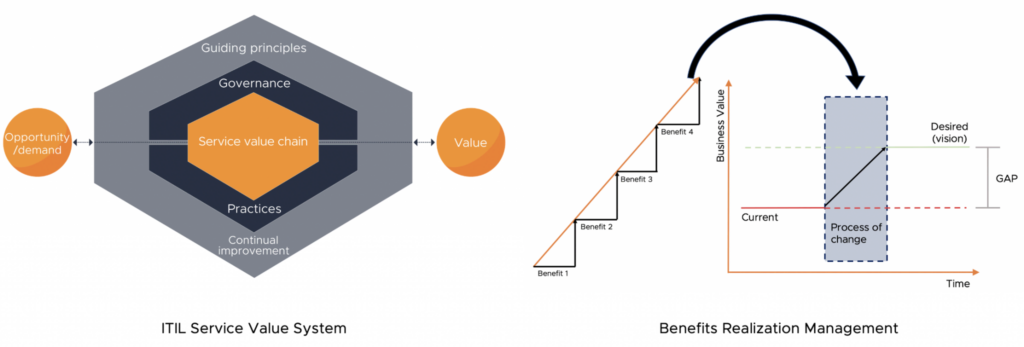
The Service Value Chain (or SVC) is also a new ITIL 4 concept and one that’s a component of the SVS. The SVC is very similar to what the PMBOK Guide calls Process Groups that form the Project Management lifecycle. Both images are included side-by-side below for comparison.

The SVC replaced a concept called the Service Lifecycle from ITIL v3 that included five phases: Service Strategy, Service Design, Service Transition, Service Operations, and Continual Service Improvement. Unfortunately, some practitioners and organizations mistakenly interpreted these phases to mean that the work to create and deliver products and services should be done sequentially. Thus, they ended up creating separate, siloed roles and teams of people, introducing unnecessary bureaucracy within and across teams, thereby slowing down how work was done (and giving previous versions of ITIL a bit of a bad name).
Project Managers had a similar issue with PMI’s Process Groups (that of Initiating, Planning, Executing, Monitoring and Controlling, and Closing), which resulted in Project Managers, teams, and organizations breaking projects into discrete, sequential phases with rigid phase gates and pushing out project timelines, rather than seeing the Process Groups (and in the case of ITIL, the Service Lifecycle phases) as loosely-based groupings of work, where activities can happen at any time and potentially be performed several times throughout the life of the project and/or overall product or service.
As part of the ITIL 4 release, the Service Lifecycle was reimagined as the SVC to provide clarity around the fact that the work needed to bring value to customers can be done in lots of different ways and is often iterative and incremental. As a side note, the ITIL 4 framework also provides an overview of a fascinating concept that comes from Lean called Value Stream Mapping. I highly recommend learning more about this concept as it helps organizations get better visibility into the high-value work that’s done throughout the organization, identify areas of waste, and make significant improvements to how the organization runs.
What’s nice about the two frameworks is that they complement one another very well. In this section, we’ll start with an overview of some of the similarities and differences and then dig into specific Project Management processes and related concepts, examining where they overlap.
The PMBOK Guide/PMP exam and ITIL books, exams, and certifications were created at around the same time (as shown below). Over the years, each framework has become the most well-known international best practice framework on their respective topics. More than one million people globally have obtained their PMP certification, and similarly, over one million people hold one or more ITIL certification.
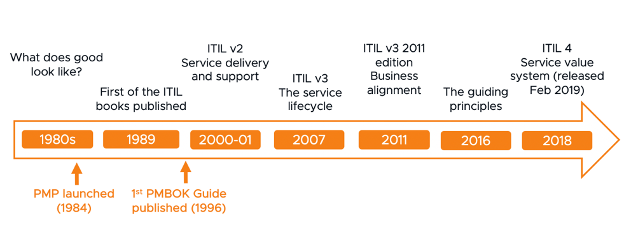
Both frameworks also share the following characteristics:
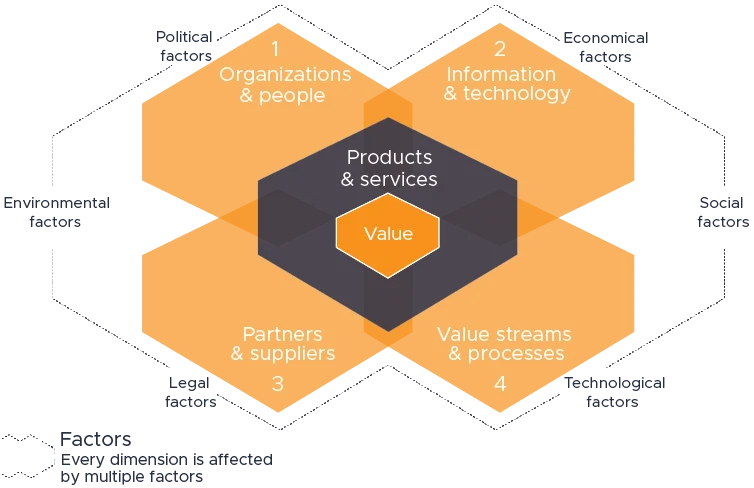
The first concept is that of the 4 Dimensions of Service Management (pictured below). The closest concept in the PMBOK Guide is that of the various “Knowledge Areas” as it defines the areas we need to consider when we are, for example, introducing change within our organization. We must look at our overall organization and its people, our partners and suppliers, the tools and technology we use (including how information and knowledge flows), and the value streams and processes we have in place and may be impacted. There is some overlap specifically here with the Integration Management, Stakeholder Management, and Procurement Management Knowledge Areas.
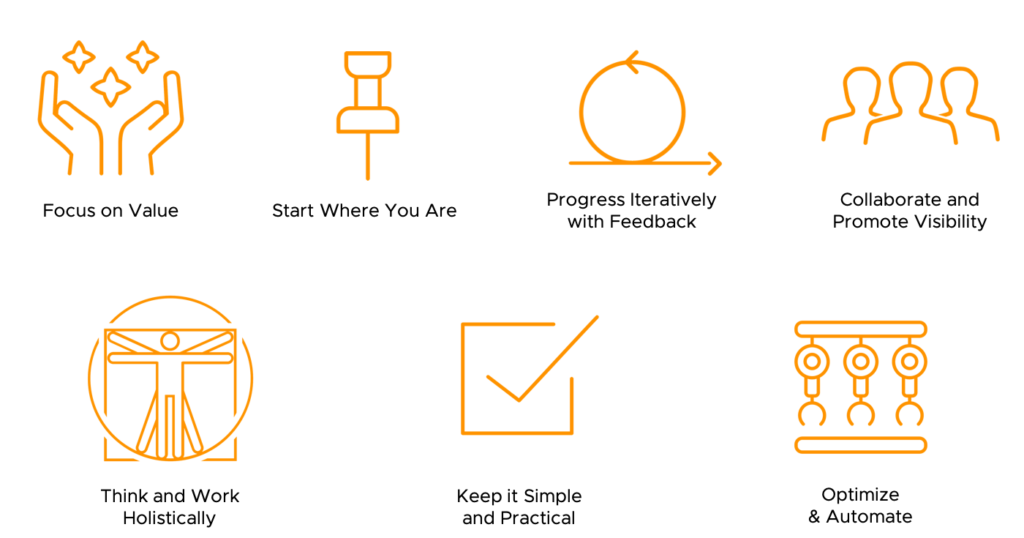
Another unique concept in ITIL 4 is that of the Guiding Principles. As in real life, being a great Project Manager goes beyond knowing what’s in the PMBOK Guide and implementing process, tools, and techniques. It starts with the right mindset, which is why the Agile movement focuses a lot of time on the concept of “being Agile” rather than just “doing Agile”. The same is true in delivering great products and services to customers. We can “do ITIL” (purchase an IT Service Management platform and define several ITIL processes); and we can still fail spectacularly in the eyes of our customers. That’s where the Guiding Principles can help. Drawn from concepts in Agile, Lean, DevOps, etc., it provides guidance on the mindset, values, and beliefs that will help drive the right behaviors across the organization.
There are several more Project Management Knowledge Areas and processes that have touchpoints with ITIL 4 practices; and this article could be much longer than it is. However, to avoid putting you to sleep, dear reader, I will call out only two additional areas of the Project Management framework where I’ve found that, depending on whether you are working inside or outside of a project, people use similar words differently. Thus, you may be saying “Knowledge Management” and assume other people understand what you’re saying. Whereas, someone that has a good understanding of ITIL concepts may use the same term but mean something different. These areas include:
One of the things I like about the ITIL 4 framework is that its content has been and is still being created and revised iteratively and incrementally. All content is reviewed by industry practitioners, feedback is gathered; and this feedback goes into the next release of content. Version 1 of the Project and Program Management Practice Guide was released a couple months ago, and it is a good start.
There are three interesting concepts contained within it, including:
This blog article is my best attempt at giving some of the highlights around ITIL 4 for Project Managers, and I have included links to further reading on several of the topics we’ve covered. However, there is a lot more to the ITIL 4 framework, and it’s worthwhile to continue learning more about it. A great place to start is by reading through our ITIL 5 Complete Guide as it has gives additional detail on the subject.
Beyond20 is a ServiceNow Elite Partner dedicated to changing work life for our clients through rapid time to value across the ServiceNow platform. We help organizations make ServiceNow work in practice and for people, combining platform-spanning expertise, practical guidance, and hands-on delivery to help teams move with confidence and see value faster.