
The Biggest ServiceNow Australia Release Updates, Explained
ServiceNow release notes aren’t exactly beach reading. They are useful, detailed, and important, but they are also written for people who need…


PMO leaders are often asked to weigh in on portfolio decisions after momentum has already started. Funding has been approved, teams have been assigned, and delivery plans are taking shape. When priorities shift or constraints appear at that point, the room to adjust is limited, and every change carries real cost.
Scenario planning in ServiceNow SPM is designed to address that timing problem. It gives PMO leadership a way to explore alternatives earlier, when trade-offs are still visible and decisions can be shaped with intent. Instead of reacting to change after it lands, leaders can compare options, understand implications, and guide direction before plans harden.
This article looks at how scenario planning in ServiceNow SPM supports earlier decision-making and why that shift matters for PMO leadership responsible for balancing strategy, capacity, and delivery.
Scenario planning in ServiceNow SPM allows PMO leaders to create alternative versions of their portfolio without disrupting active plans. Each scenario reflects a different set of assumptions, whether those assumptions involve funding levels, strategic priorities, or available capacity.
Because scenarios are built on real portfolio data, the outputs reflect how the organization actually operates. Costs, timelines, demand, and capacity remain grounded in current conditions rather than estimates assembled outside the platform. This grounding is what makes scenario comparisons useful rather than theoretical.
For PMO leadership, this changes the tone of planning conversations. Discussions move away from abstract debate and toward shared evaluation of realistic options, which makes it easier to align stakeholders and guide decisions with confidence.
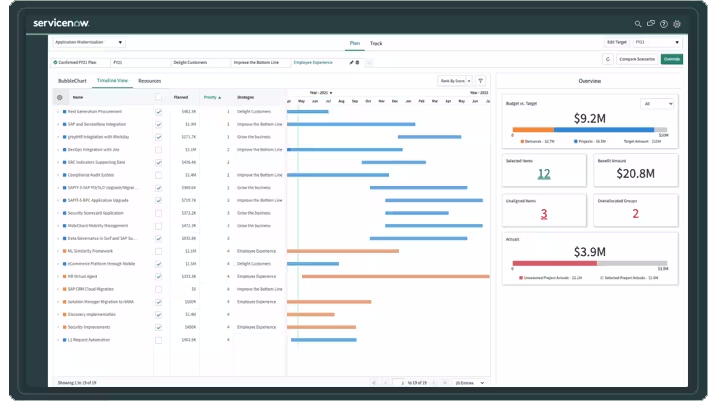
Scenario planning becomes meaningful when it supports the decisions PMO leaders are accountable for. Two common situations illustrate how this plays out in practice.
Mid-year budget adjustments are common, but their impact often becomes clear only after delivery plans are already in motion. At that point, conversations tend to focus on what must be cut rather than what can be preserved.
With scenario planning in ServiceNow SPM, PMO leadership can model a reduced-budget scenario before changes are finalized. The platform recalculates forecast costs, highlights delivery impacts, and surfaces where business value is most affected. This allows leaders to present options that balance financial constraints with strategic outcomes.
Instead of reacting to a mandate, PMO leaders can guide the discussion toward intentional trade-offs supported by data.
Strategic direction can change quickly, even when the portfolio reflects decisions made months earlier. New priorities introduce tension between what is already planned and what leadership now expects.
Scenario planning allows PMO leaders to clone the current portfolio and adjust strategic weighting to reflect the new direction. Comparing scenarios shows how capacity, funding, and timelines respond to that shift. It also provides a clear foundation for explaining why certain initiatives move up, others move down, and some no longer align.
The goal is not to arrive at a perfect plan. It is to align leadership around a plan that reflects both strategy and reality.
Without scenario planning, portfolio discussions often rely on interpretation. Teams talk about risk, impact, and constraints, but those conversations tend to remain conceptual.
Scenario planning introduces a different dynamic. What-if questions become structured comparisons. PMO leaders can review how reallocating resources affects delivery timelines, where capacity conflicts appear, and which initiatives compete for the same constraints. Over time, this approach reduces rework, shortens decision cycles, and increases confidence in the decisions that follow.
The Zurich release continues to strengthen strategic portfolio management on the ServiceNow platform, particularly in areas that support decision quality and usability. Expanded generative AI capabilities through Now Assist help teams summarize demand intake, draft planning narratives, and surface insights from portfolio data more efficiently.
These capabilities are designed to reduce administrative effort rather than replace judgment. For scenario planning, that means less time assembling context and more time interpreting outcomes. PMO leadership remains responsible for the decisions themselves, with AI supporting the work that leads up to them.
Scenario planning in ServiceNow SPM supports a more deliberate approach to portfolio decision-making. When PMO leaders can explore alternatives before commitments are locked in, discussions around budget, priority, and risk gain structure and clarity.
The scenarios themselves are not the end goal. The real benefit comes from understanding the consequences of decisions while there is still room to adjust course.
For PMO leaders, scenario planning in ServiceNow SPM creates space to lead with intent. It enables earlier evaluation, clearer communication, and more confident recommendations.
With Zurich’s AI-supported capabilities reducing friction around preparation and communication, PMO leadership can focus attention where it matters most. Interpreting outcomes, guiding priorities, and aligning stakeholders around informed decisions remain central to the role.
Uncertainty does not disappear, but scenario planning provides a disciplined way to work through it and move forward with confidence.