
ITIL Maturity Assessment | Global Aviation Technology Provider
Cleared for Improvement: How a Global Aviation Technology Provider Turned ITIL Maturity Findings Into a ServiceNow Roadmap The Client This…


Most organizations hire employees based on their credentials, but how do they know whether they really have the “know how” the organization needs to succeed or have the skills required to perform their jobs well? In today’s economy, it takes more than hiring talented employees and providing them with professional development opportunities for an organization to thrive. Beyond developing employees, many organizations could do a better job of and, frankly, gain a lot of benefit from learning from their customers and from their own successes and failures. Thus, the most successful organizations create a culture of “continuous learning.”
Continuous learning is especially important for digital businesses which must constantly adapt to rapidly changing market conditions and emerging technology. In this article, we will discuss how continuous learning applies to all levels of the organization along with how continuous learning can help make your organization more resilient, collaborative, and a lot more fun as a place to work.
Continuous learning, sometimes called “constant learning,” is a process of learning new skills and knowledge and reflecting on individual and group experiences on an ongoing basis. To be clear, sometimes the terms continuous learning and “lifelong learning” are used interchangeably, though in this context they are not the same. The latter refers most commonly to an individual who actively takes classes and participates in skill-building activities for their entire lives; the focus is on the individual.
In the context of this article, continuous learning applies at the individual, team, and organizational level. The focus is on making sure that individuals have relevant skills to support their teams and workgroups; that teams routinely reflect on shared experiences and lessons learned through “retrospectives”, etc.; and that the organization as a whole learns from both internal experiences and external sources such as customers, market trends and demand, and even competitors.
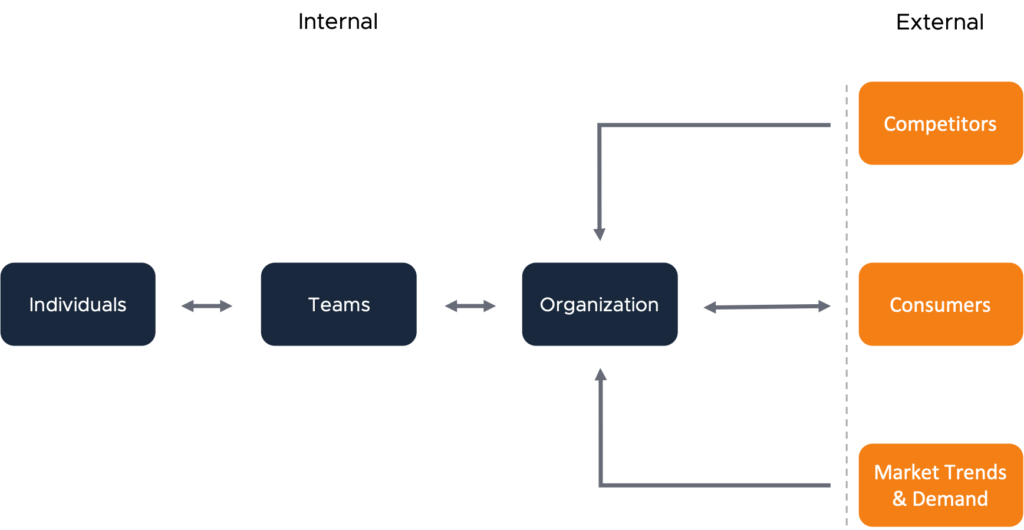
Although the levels of formality associated with continuous learning programs vary from organization to organization, a common thread is that intentionality is placed on ensuring that the learning at all levels directly supports organizational agility. It is more than “on the job training” or “training by fire.” Organizations that practice continuous learning recognize that it is necessary to support continual renewal and improvement.
Digital business is driven by innovation. The word “innovation” itself is used almost as broadly as the phrase “digital transformation.” Innovation perpetuates both destruction and renewal.
Innovation is about the organization constantly tearing down what is familiar and comfortable and building up something new (and hopefully better) in its place.
The perpetual destructive and creative processes of innovation are critical for digital businesses which are highly sensitive to demand and customer preferences, reliant on the latest tools and technology, and constantly under pressure from competitors. Although defining exactly what a digital business is can be tricky, it is fair to say that the hallmarks of digital business are speed, flexibility, and the ability to quickly respond to change.
But innovation does not happen by magic. It requires new skills and new combinations of skills, new ways of working, and a new mindset. While digital businesses start by hiring employees with required skills, continuous learning ensures that as the business landscape changes, the organization will continue to be prepared by having employees with up-to-date skills and teams that are aware of consumer demand, competitive forces, and the overall state of the market.
Leadership at all levels of the organization sets the intention for continuous learning. At the highest levels, leaders need to determine where the organization is lacking in knowledge and how to bridge the gap. For example, leaders in one organization may realize that senior leadership is not up to date on digital technology trends and decides to establish a technical advisory board, in partnership with IT, to apprise decision-makers of the threats and opportunities offered by emerging technologies. In another organization, leaders may realize that they are finding out about competitor tactics and external threats too late to effectively counter them and so decide to establish a competitive intelligence practice. One organization I worked with did precisely this and hired two employees to focus on the activities of competitors. Each day, the competitive intelligence team provided daily fifteen-minute long recorded briefs on daily competitive moves and market trends. Although solving customer needs remained paramount for the organization (and normally solving customer problems should come before countering competitive forces), knowledge of market and competitors created a more balanced view of the overall ecosystem.
Leadership also has a role to play in determining the critical skills the organization needs to accomplish its mission. For example, an aspiring digital business interested in creating a multi-channel experience for consumers finds that it lacks skills in building an online business model. This requires assembling teams with specific skills in customer experience management, channel marketing, and web development. Senior leadership then works with Human Resources and a variety of teams to understand what skillsets currently exist in the organization, which can be developed internally through training, and which need to be hired.
Learning organizations start by hiring curious people who have the skills that are needed and who have the willingness to expand their skillsets over time. To this extent, Human Resources Leadership, at a high-level, has the potential to do much more than manage benefits and hiring policies. It has the possibility of being a hub of Human Capital Management (or as ITIL calls it, Workforce and Talent Management). What is clear, though, is that while hiring curious and skilled workers is necessary, continuous learning starts well before the hiring process by envisioning what learning means to the organization. It also continues well beyond onboarding by having a semi-structured path for employee skill development, and an understanding of how both teams and individuals can contribute concretely to fulfilling the organizational learning vision.
It goes without saying that team-level learning goals should be aligned with leadership’s overall vision and organizational priorities. Of course, in reality, executive vision does not always trickle-down to other levels of the organization, and teams often play a key role in informing senior leadership about learning gaps. This notwithstanding, continuous learning at the team level focuses on ensuring that teams are learning how to continually improve their collective performance and that team members have appropriate and even complementary skills. Some examples of how teams can learn, pulled from ITIL/IT Service Management and Agile/Scrum, include:
For more ideas on ways to encourage “continuous learning” and knowledge sharing within and across teams, read this article on, “An Overview of the Knowledge Management Practice, Tools, and Techniques in ITIL 4”
To the extent that teams and workgroups are often best positioned to understand how work actually gets done (and in some cases work directly with customers), the execution of continuous learning activities is largely the responsibility of teams.
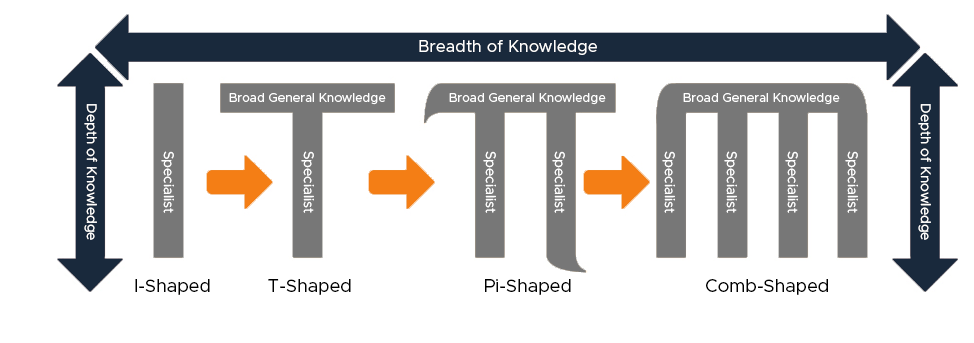
Without any doubt, individual employees need to possess or acquire the skills needed to perform their jobs and contribute to their teams. For each of us, it is important to remember that the skills possessed when starting with an organization need to be refreshed, and as our roles change, new skills need to be developed. As a friend once shared with me, we should think about solidifying and updating our current skillsets while incrementally branching-out and learning new or complementary skills. For example, a budgeting specialist needs to stay current with the latest budgeting techniques and with organizational financial policies but may also need to learn some project management and reporting skills. Thus, as we acquire more skills, our value to our organization increases. Try developing deep competence within one-to-three areas of subject matter expertise (what is termed a “comb-shaped” person) and complementary secondary skills.
Continuous learning is about intentionality. It is not uncommon for curious employees to pursue skills that are of little direct value to the organization. To this end, an employee’s manager plays an important role in evaluating individual learning goals and how these align with the team and the organization at large. It is good practice is to give individuals freedom to pursue some learning goals and develop skills that are not directly aligned with team needs as long as directly relevant skills are being developed. For example, in one small organization, the leadership team instructed every team member to take a class or learn something that had no direct relationship to their job as long as they reported back what they learned to the entire team. Although this approach is unique and may not work with every organization, some version of this approach can serve as a great way to keep employees engaged in learning.
One of the most difficult aspects of continuous learning is finding ways for employees to share knowledge and to ensure that the organization benefits from individual employee knowledge. Though broad in nature, the ITIL 4 practice of Knowledge Management addresses the issue of knowledge appropriability (making knowledge useful to the organization) and the transference of knowledge from the head and onto paper.
In theory, continuous learning sounds like a winning proposition. In reality, creating a culture of continuous learning can take a long time and involves a multi-pronged approach. Now that you know the key aspects of continuous learning, how do you put the knowledge to work? Here are some great ideas we have seen work well:
When hiring, many organizations place too much emphasis on finding candidates who have skills to do today’s job. To be sure, doing today’s job is important. But it is important to also consider hiring employees that show a dedication to lifelong learning, to adaptability, and who have or can easily learn the skills needed for tomorrow. For example, one of our clients, a major hotel and hospitality company, routinely needs to hire employees with “bread and butter” IT skills (programming, server maintenance, networking, etc.). However, given the importance of customer data to their industry, several years ago they began to hire employees with business intelligence and data analytics skills to slowly build their data analytics practice.
Beyond20 is a ServiceNow Elite Partner dedicated to changing work life for our clients through rapid time to value across the ServiceNow platform. We help organizations make ServiceNow work in practice and for people, combining platform-spanning expertise, practical guidance, and hands-on delivery to help teams move with confidence and see value faster.